arXiv 2026 · Pediatric Skull CT · Bi-planar X-ray · Geometry-aware Reconstruction

PSCT-Net: Geometry-Aware Pediatric Skull CT Reconstruction via Differentiable Back-Projection and Attention-Guided Refinement

PSCT-Net reconstructs 3D pediatric skull CT volumes from frontal and lateral X-rays by explicitly injecting acquisition geometry into the network and refining the resulting volumetric prior with attention-guided projection and bidirectional state-space modeling.

Dong Yeong Kim, Jaewon Choi, Youmin Shin, Jungyu Lee, Myeongseop Kim, Jinwook Choi, Joo Whan Kim, Young-Gon Kim

Seoul National University · Seoul National University Hospital · Yonsei University · Seoul National University Children’s Hospital

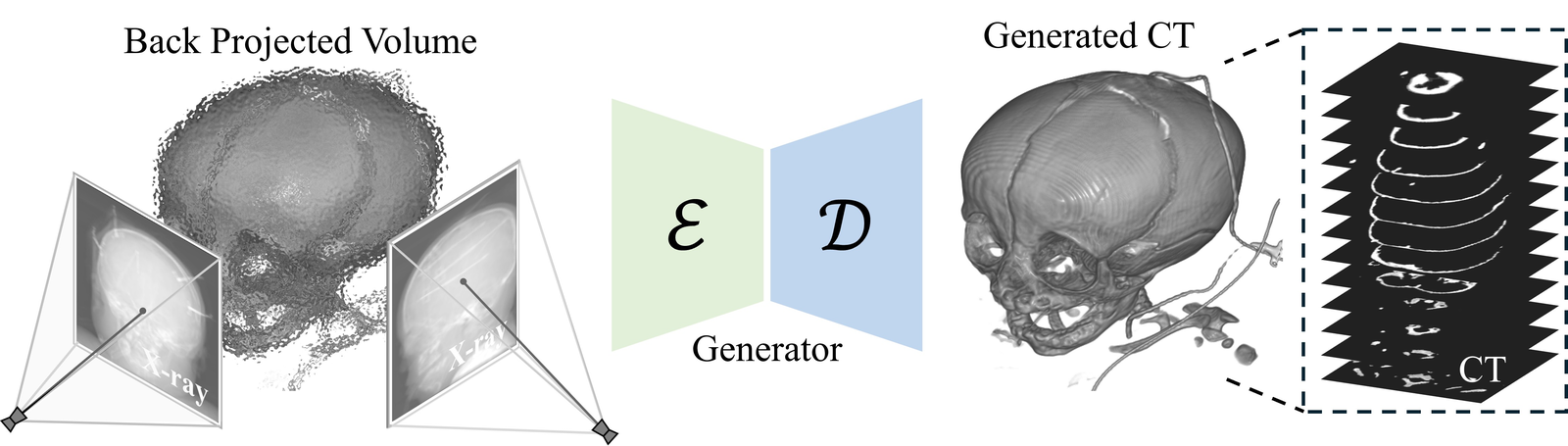
PSCT-Net teaser showing back-projected volume and generated CT reconstruction

Teaser. Frontal and lateral X-rays are back-projected into a coarse volumetric prior, then refined to reconstruct a high-fidelity CT volume.

Abstract

Low-dose pediatric cranial reconstruction with explicit geometry.

CT is essential for diagnosing pediatric craniofacial abnormalities, but radiation exposure is a major concern in young patients. Reconstructing CT from sparse bi-planar X-rays is attractive but severely ill-posed because two projections do not directly encode volumetric depth.

PSCT-Net addresses this by replacing geometry-agnostic feature lifting with differentiable back-projection, attention-guided 2D-to-3D projection, geometry-aware multi-view conditioning, and bidirectional Mamba-based volumetric context modeling.
Motivation

Why explicit acquisition geometry matters

01

Geometry-agnostic lifting

Naive replication or linear projection of 2D features into 3D can produce spatial misalignment and depth ambiguity.

02

Diffusion-based reconstruction

Iterative denoising can improve realism but is computationally expensive for time-sensitive clinical workflows.

03

PSCT-Net

Back-projection creates a spatially faithful prior, while AGP-3D and BiM-3D refine local correspondence and global cranial structure.

Method

Geometry-aware 2D-to-3D reconstruction

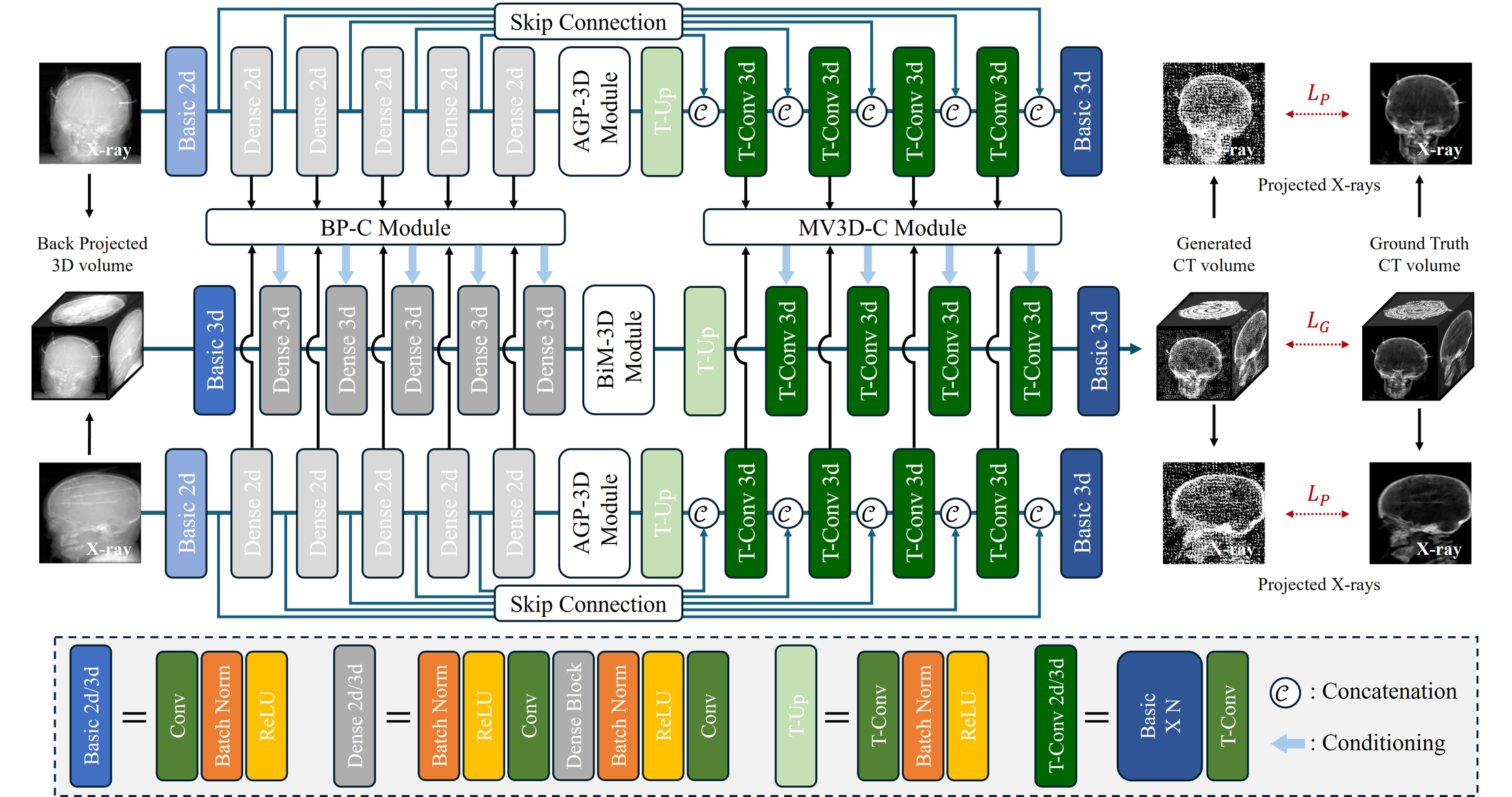
The model initializes a 3D volume via differentiable back-projection, then refines the volume using geometry-aware conditioning, attention-guided projection, and bidirectional state-space modeling.

Overall PSCT-Net architecture

Framework overview. A coarse back-projected prior is refined by an encoder-decoder network conditioned by BP-C and MV3D-C modules.

01

Differentiable back-projection

Projects frontal and lateral X-ray intensities along physical ray paths to form a geometry-aligned volumetric prior.

02

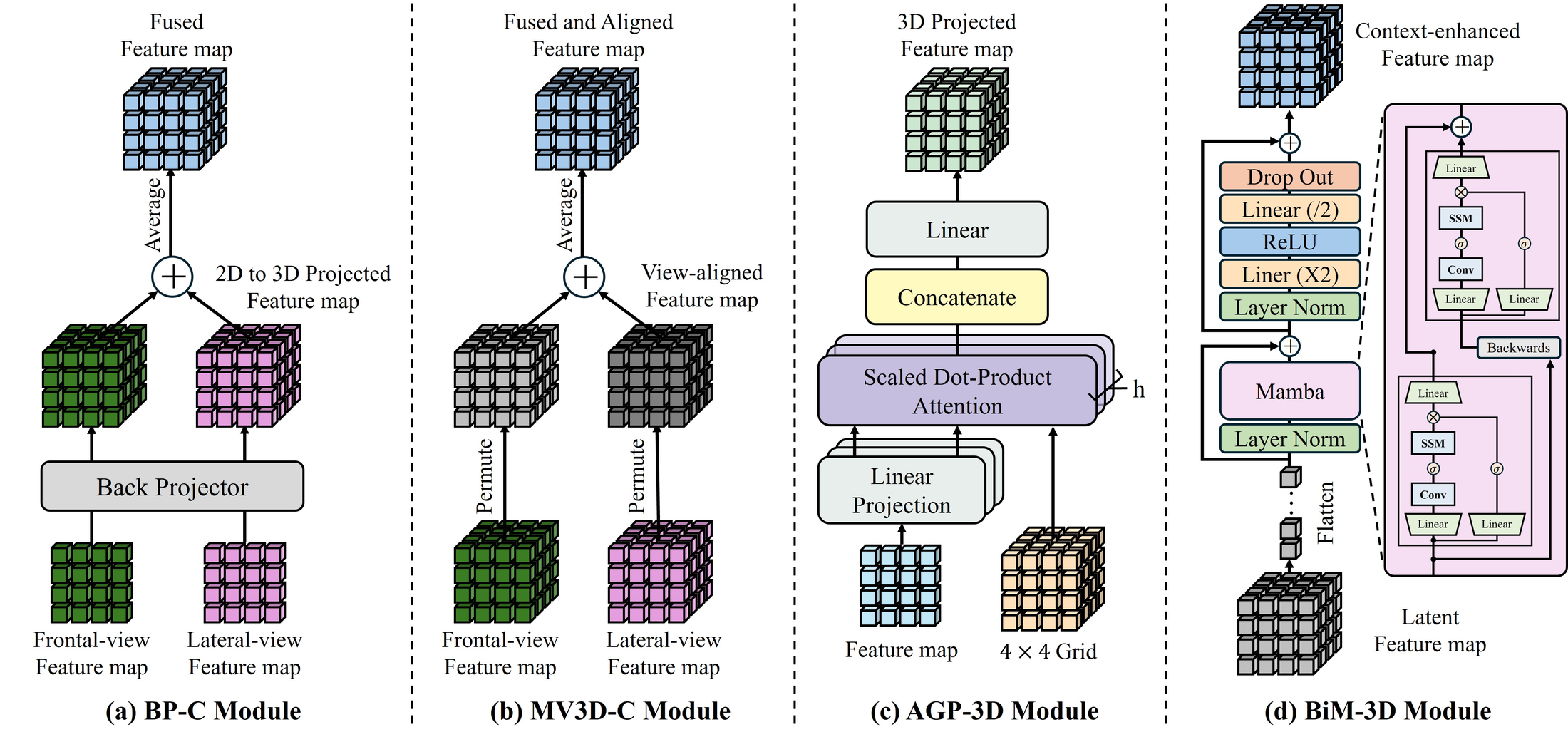
BP-C and MV3D-C

Injects geometry into encoder and decoder stages through back-projected 2D features and aligned multi-view 3D features.

03

AGP-3D

Uses multi-head attention to learn non-linear voxel-wise correspondence between 3D grid queries and 2D feature tokens.

04

BiM-3D

Models long-range volumetric context with bidirectional selective state-space modeling at linear sequence complexity.

Visualization of BP-C, MV3D-C, AGP-3D, and BiM-3D modules

Core modules. BP-C, MV3D-C, AGP-3D, and BiM-3D provide geometry-aware lifting and efficient volumetric refinement.

Training objective L = lambda_adv L_adv + lambda_rec L_rec + lambda_proj L_proj

Dataset

Private pediatric cohort and public anatomical benchmarks

PedSkull-CT

PedSkull-CT is a private institutional pediatric skull CT cohort used for internal evaluation. It contains normal and pathological cases from patients aged 1-24 months.

Release status: PedSkull-CT is not redistributed in this repository due to institutional privacy and data-use restrictions.

CT scans982
Age range1-24 months
Split883 train / 99 test
Voxel size128^3 after preprocessing
X-ray inputsDRR + style transfer
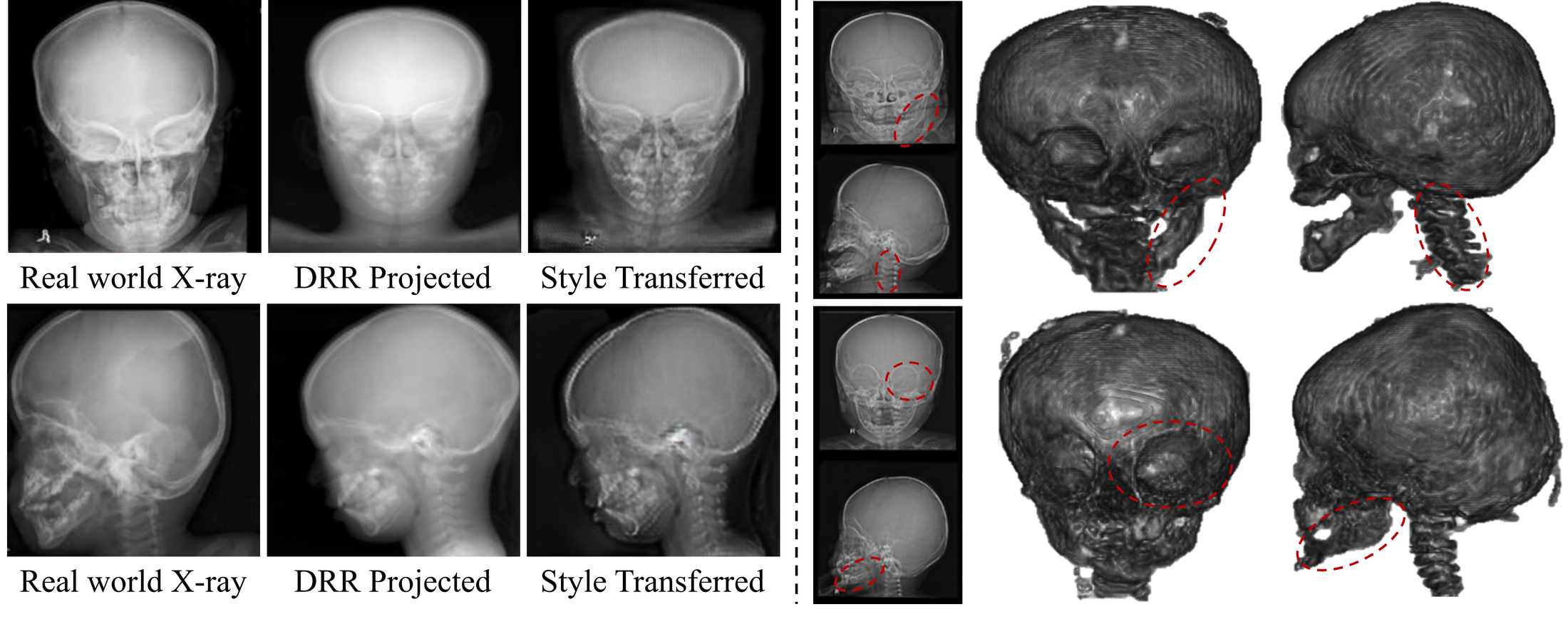
Real-world X-rays, DRR projections, style-transferred X-rays, and real-world reconstructions

Data pipeline and real-world evaluation. DRRs are translated to realistic X-ray style, and real clinical X-rays are used for qualitative generalization analysis.

LIDC-IDRI

Thoracic CT benchmark with 917 training and 101 testing cases.

CTSpine1K

Spinal CT benchmark with 904 training and 101 testing cases.

CTPelvic1K

Pelvic CT benchmark with 424 training and 43 testing cases.

Results

Reported reconstruction performance

PSCT-Net achieves strong quantitative performance across public benchmarks and the private PedSkull-CT cohort, while preserving single-step inference characteristics.

Public benchmarks

DatasetMetricSecond-bestPSCT-Net
LIDC-IDRIPSNR ↑26.3527.18
LIDC-IDRIPSNR3D ↑21.6422.14
LIDC-IDRILPIPS ↓0.1140.102
CTSpine1KPSNR ↑21.5721.86
CTSpine1KPSNR3D ↑21.1221.15
CTPelvic1KPSNR ↑31.7133.06
CTPelvic1KSSIM ↑0.7530.786
CTPelvic1KLPIPS ↓0.1130.108

Private PedSkull-CT

MethodPSNR ↑SSIM ↑LPIPS ↓
ReconNet25.220.6330.537
X-CTRSNet24.270.7880.498
X2CT-GAN30.210.8600.113
TRCT-GAN29.920.8470.123
BX2S-Net29.730.7770.298
PSCT-Net31.490.8820.100
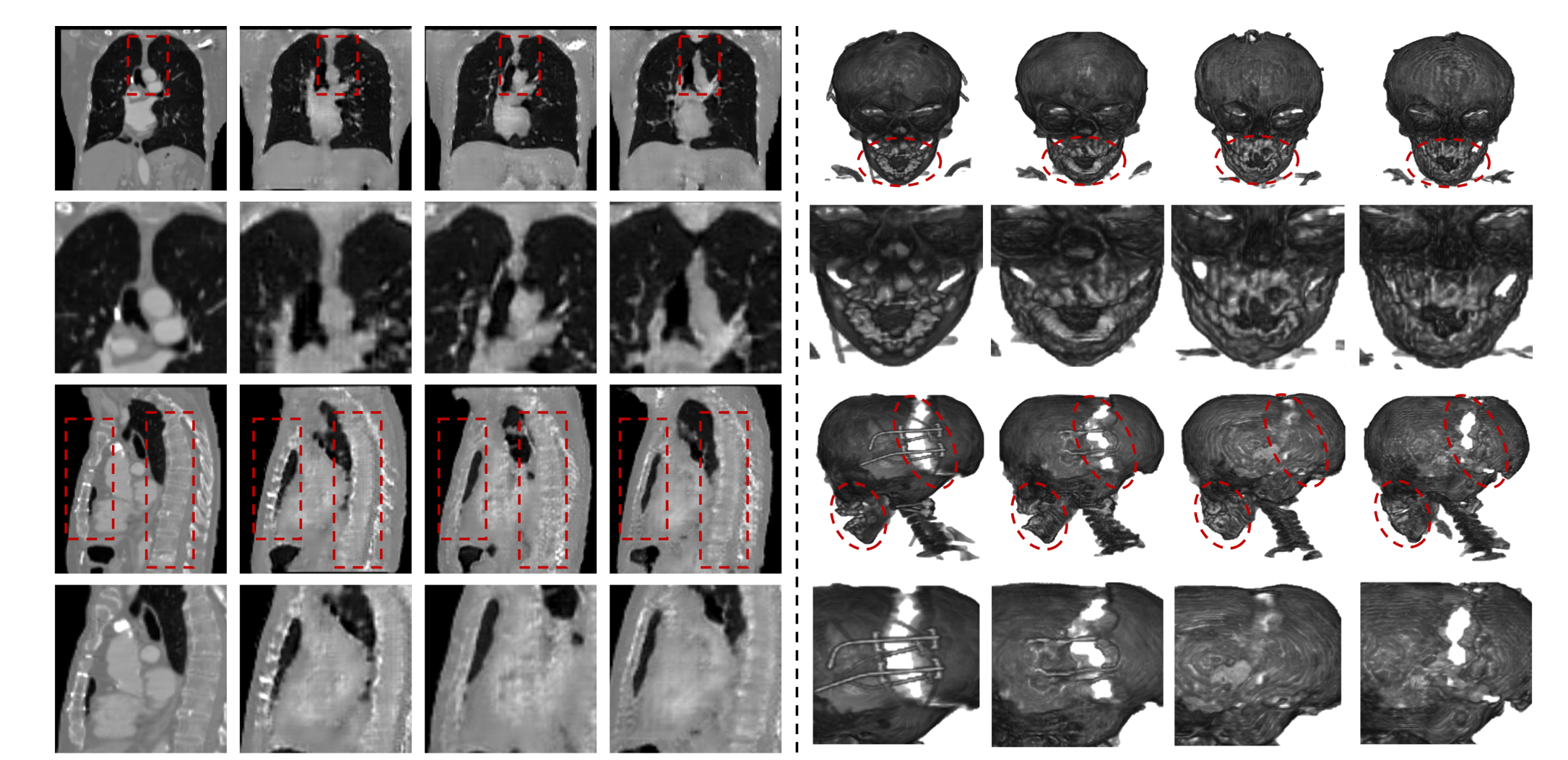
Qualitative comparison of PSCT-Net, TRCT-GAN, and X2CT-GAN reconstructions

Qualitative comparison. Red dashed regions highlight fine structures and hallucination-prone areas where PSCT-Net better preserves anatomy.

Ablation study on LIDC-IDRI

BP-IBP-CAGPBiMPSNR ↑SSIM ↑
26.030.645
26.300.647
26.400.648
26.920.649
27.070.665
26.850.651
27.160.669
27.180.671

Materials

Code, paper, and data terms

PedSkull-CT

Private institutional cohort used for internal validation; not publicly redistributed.

See data terms

Citation

Cite PSCT-Net

Proceedings details can be updated after the final venue version is available.

@misc{kim2026psctnet,
  title         = {PSCT-Net: Geometry-Aware Pediatric Skull CT Reconstruction via Differentiable Back-Projection and Attention-Guided Refinement},
  author        = {Kim, Dong Yeong and Choi, Jaewon and Shin, Youmin and Lee, Jungyu and Kim, Myeongseop and Choi, Jinwook and Kim, Joo Whan and Kim, Young-Gon},
  year          = {2026},
  eprint        = {2606.19867},
  archivePrefix = {arXiv},
  primaryClass  = {cs.CV}
}